


























Views
Downloads

Essential Area of Parallelograms Decimals Worksheet Grade 5
Paste this activity's link or code into your existing LMS (Google Classroom, Canvas, Teams, Schoology, Moodle, etc.).
Students can open and work on the activity right away, with no student login required.
You'll still be able to track student progress and results from your teacher account.
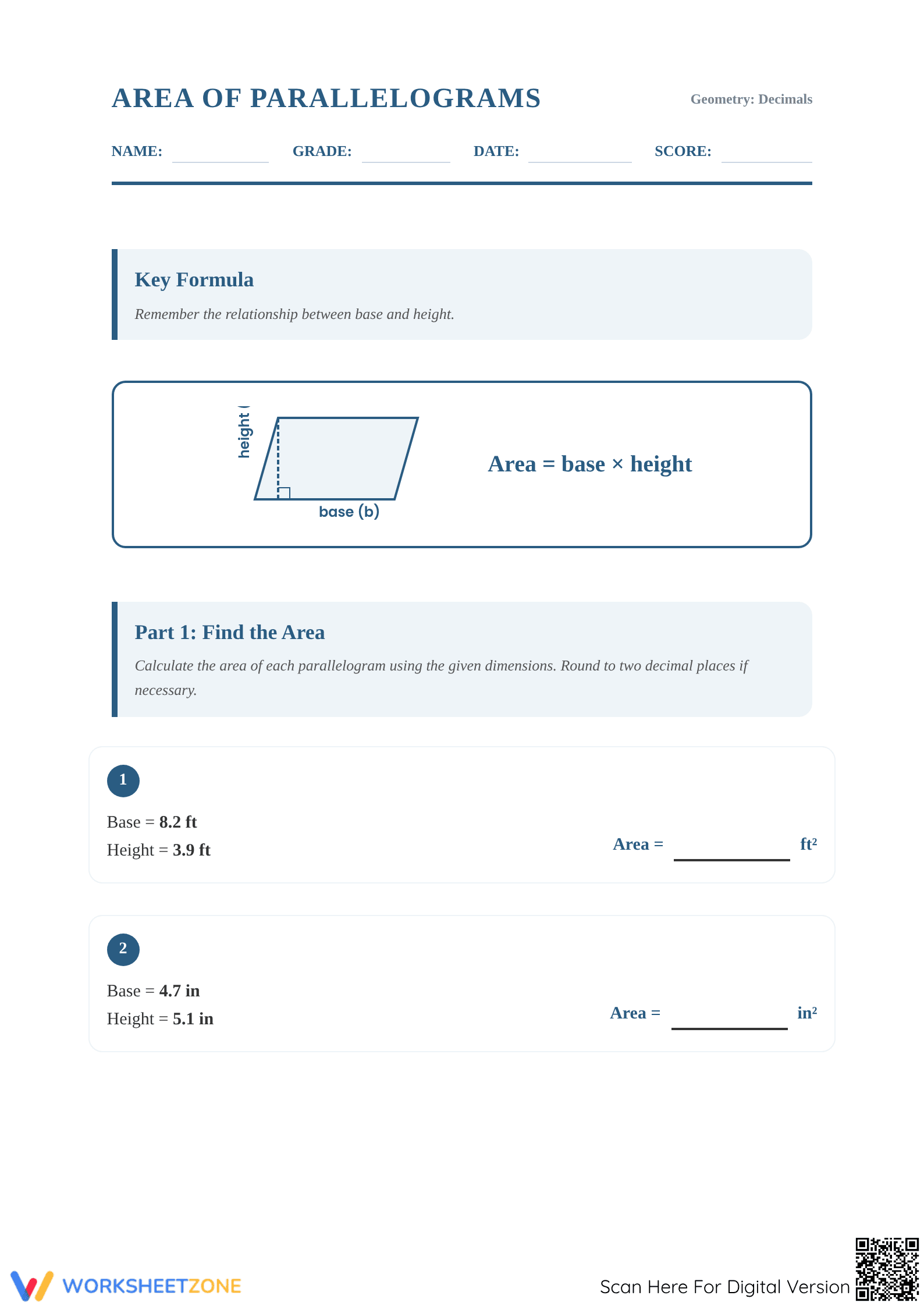
This Essential Area of Parallelograms Decimals Worksheet helps Grade 5 students master geometric calculations involving non-integer dimensions. Students apply the area formula to various parallelograms, solve for missing bases or heights, and tackle real-world word problems. This comprehensive resource ensures students build the conceptual bridge between linear measurements and two-dimensional space through rigorous, structured practice.
At a Glance
- Grade: 5 · Subject: Math
- Standard:
CCSS.MATH.CONTENT.6.G.A.1— Find the area of special quadrilaterals and polygons by composing into rectangles- Skill Focus: Area of parallelograms with decimals
- Format: 4 pages · 15 problems · Answer key included · PDF
- Best For: Homework, independent practice, or formative assessment
- Time: 30–45 minutes
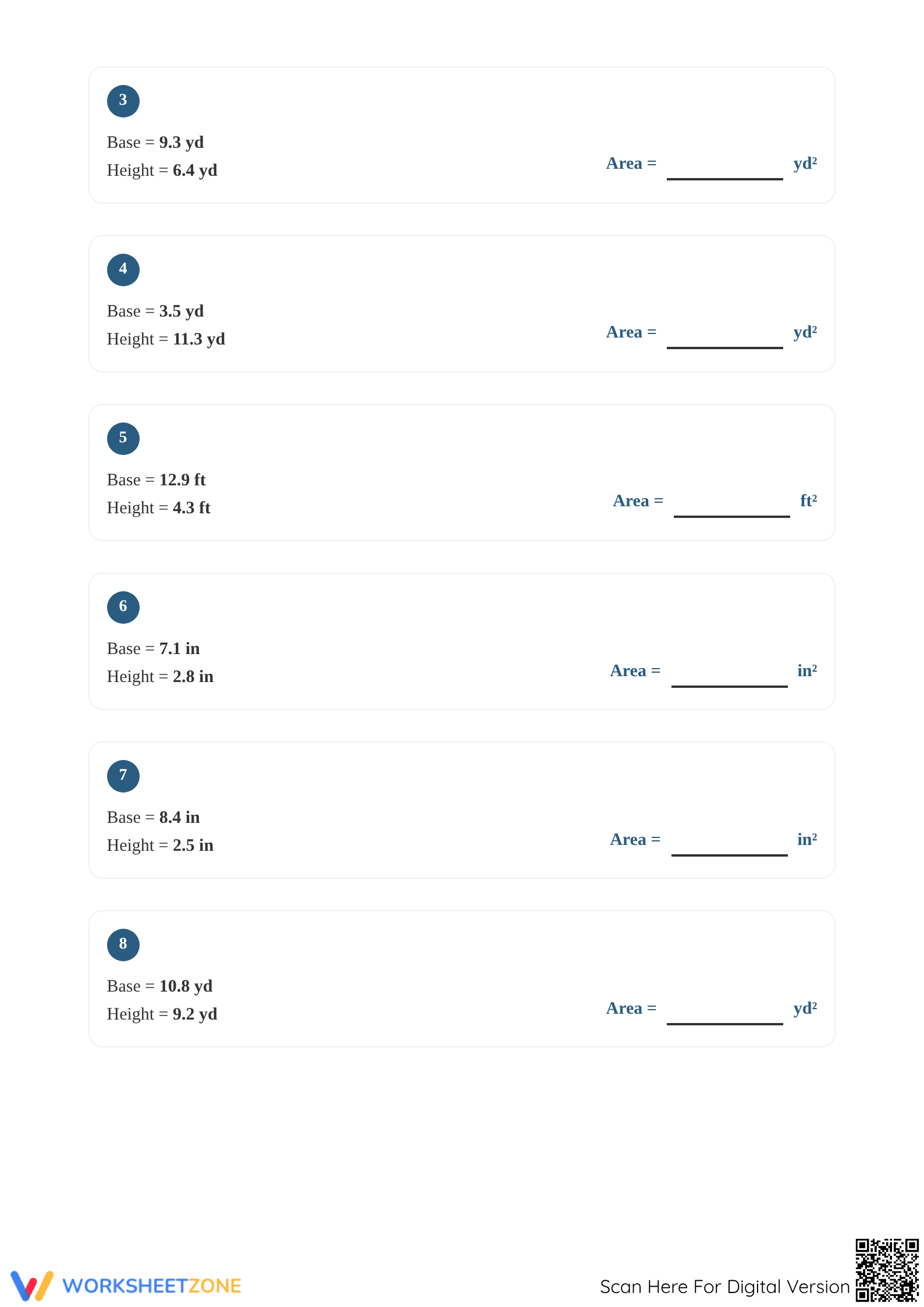
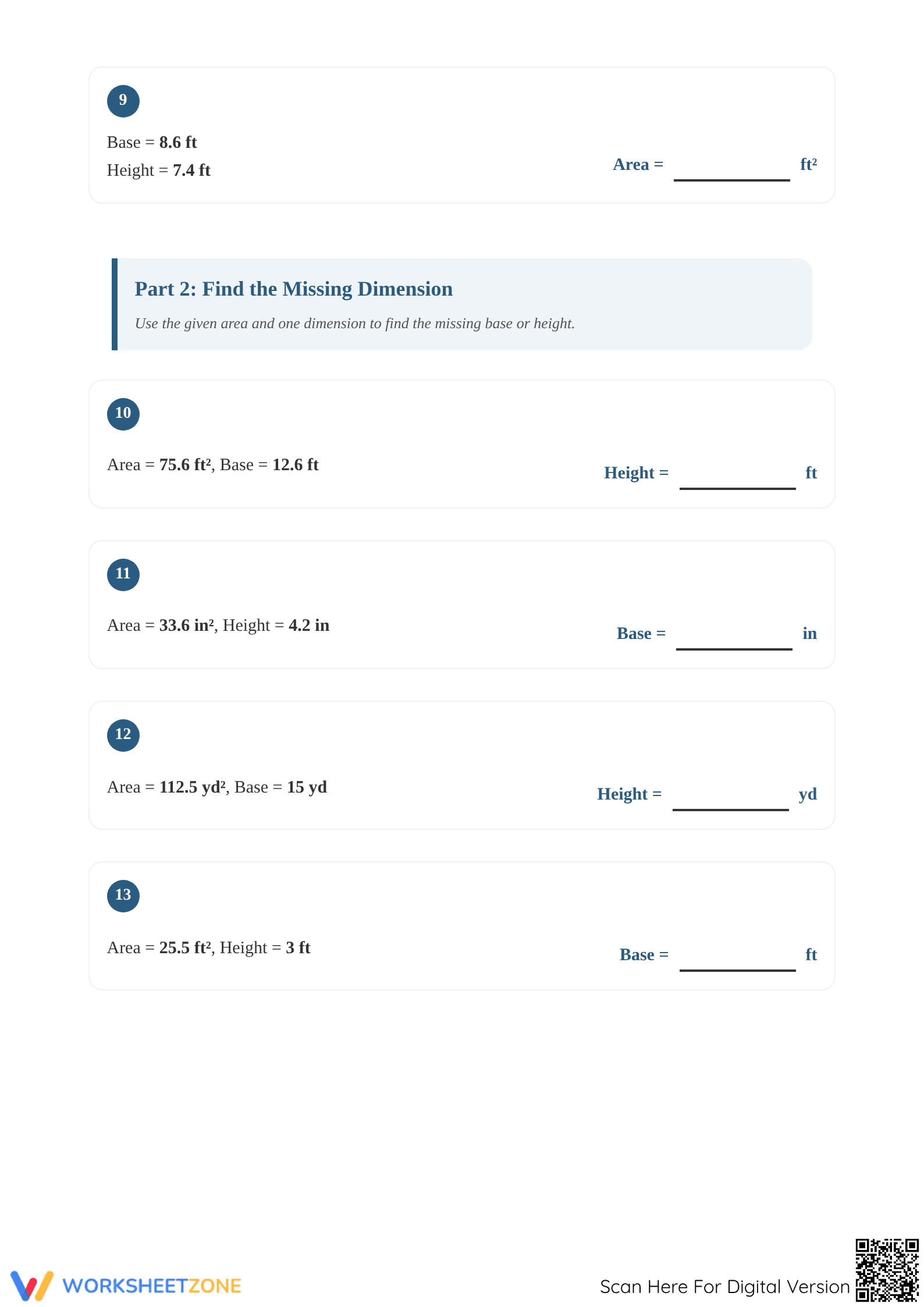
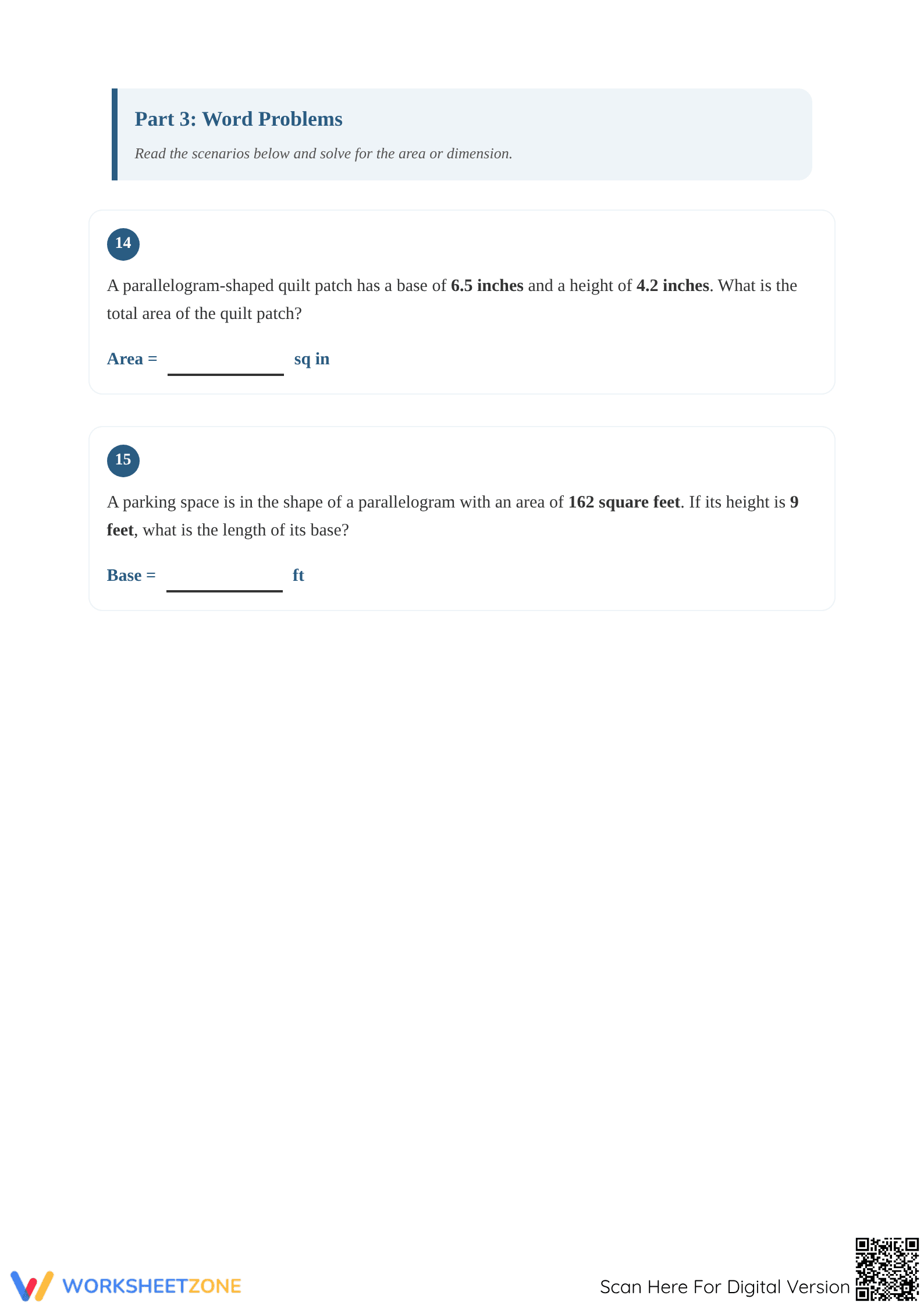
This four-page instructional packet includes a dedicated formula reference section with visual aids, 9 computational area problems using decimal values, 4 algebraic tasks requiring students to find missing dimensions, and 2 contextual word problems. The layout provides ample workspace for calculations, and a complete answer key is provided to facilitate rapid grading or student self-correction.
Teachers can implement this resource in under two minutes by following three simple steps. First, print the four-page PDF directly from your browser or device. Second, distribute the worksheets to students during the independent practice phase of your geometry unit. Finally, use the included answer key to review solutions as a whole class or to grade submissions efficiently. It is a perfect choice for unexpected substitute plans or as a ready-made morning work activity.
The primary focus of this worksheet is CCSS.MATH.CONTENT.6.G.A.1, which requires students to find the area of special quadrilaterals and polygons by composing into rectangles or decomposing into triangles and other shapes. Additionally, it supports CCSS.MATH.CONTENT.5.NBT.B.7 by requiring operations with decimals to the hundredths place. Both standard codes can be copied directly into lesson plans, IEP goals, or district curriculum mapping tools.
Use this worksheet as a mid-unit formative assessment after students have mastered the basic area formula using whole numbers. During the activity, circulate the room to observe if students are correctly rounding to two decimal places, a common point of struggle. This exercise typically takes 35 minutes to complete and serves as an excellent transition between basic geometry and more complex algebraic problem-solving.
This resource is designed for Grade 5 and Grade 6 students who are solidifying their understanding of geometric formulas and decimal operations. It is particularly beneficial for students needing extra practice with the inverse relationship between area and its dimensions. Pair this worksheet with a physical or digital anchor chart showing the decomposition of a parallelogram into a rectangle for visual support.
The Area of Parallelograms Decimals Worksheet provides essential practice for Grade 5 students, focusing on the application of geometric formulas in the context of decimal operations. According to the RAND AIRS 2024 report, high-quality, standards-aligned instructional materials are critical for bridging the gap between procedural fluency and conceptual understanding in middle school mathematics. By requiring students to calculate areas, solve for missing variables, and interpret word problems, this resource aligns with best practices for mathematical rigor. Research indicates that frequent, focused practice on multi-step geometry problems improves student retention of spatial concepts and algebraic thinking. This worksheet’s 15 tasks are structured to provide a logical progression from direct application to higher-order reasoning. Educators can reliably use this tool to meet state frameworks while providing students with the precision-based practice necessary for standardized test success and future STEM-based curriculum pathways.


